
A gutter job should ask for milestone payments when you have to buy materials before you install, the work runs more than one day, or the total is far above what the customer usually spends on a repair. Small fixes, like a downspout or a few hangers, are simpler billed once at completion. Everything in between comes down to how much money you have in the job before the customer pays.
Payment rules for home improvement work vary by state, and some states cap deposits tightly. The rules below come from state agencies and show how different the states are. They don't tell you what your state allows. Check with your state's contractor board, consumer protection office or an attorney before you set your own schedule.
What makes a gutter job big enough for milestone payments?
A gutter job is big enough for milestones when you are carrying real money in materials and labor before the customer pays. The Minnesota Attorney General's home building handbook makes the same point: payments should track the work done and materials committed, not a large sum up front.
On gutter work, three signs point to milestones:
- You buy material first. Coil in a custom color, copper half-rounds, or gutter guards ordered for one house.
- It takes more than one day. Tear-off and fascia repair on day one, new runs and downspouts on day two.
- The total is big for this customer. A homeowner used to paying for a cleaning or a small fix is now looking at a full-house seamless install.
A short repair, such as replacing one section, an outlet, a few hangers or a downspout, usually works best as one payment when you finish. Splitting a small repair into milestones adds paperwork for both of you and protects almost nothing.
How much of a deposit should I ask for on a gutter job?
A small deposit at approval is the safest start, sized to your state's rules and the materials you must order. The rules differ more than most pros expect, so look up your own state before you print a contract.
- California limits a home improvement down payment to $1,000 or 10% of the contract price, whichever is less, with no exception for special-order material, according to the California Contractors State License Board.
- Pennsylvania generally allows up to one-third of the contract price plus special-order materials on projects over $5,000, per the Pennsylvania Office of Attorney General, which also recommends payments as work progresses.
- Massachusetts generally caps an advance deposit at one-third of the price, or the actual cost of special-order or custom materials that must be bought before work starts, per the Massachusetts Office of Consumer Affairs and Business Regulation.
On an install, a deposit that covers the coil and the special-order parts you can't return is a sensible target, kept inside whatever your state allows.
Where should each payment land on a seamless gutter install?
Each payment should land on a piece of finished work the customer can see, not on a calendar date. A practical three-step schedule for a seamless install:
- Deposit when the customer signs.
- Second payment after the materials are delivered and the old gutters are off.
- Final payment after the new gutters, downspouts, slope, outlets and cleanup pass the customer's walkthrough.
Matching payments to work is the rule in several states. California bars progress payments that run ahead of the value of work completed, apart from the allowed down payment. Delaware's home improvement law names gutters and downspouts as covered work and requires each payment before completion to match specified work, materials or services.
Worked example: a $4,800 seamless gutter install
Here is the schedule on a $4,800 example install of new seamless aluminum gutters and downspouts on a two-story house. The price and split are an example, not a market rate or a legal limit.
- At signing: $480 deposit (10%).
- Materials delivered and old gutters removed: $1,920 (40%).
- After install, downspout testing and cleanup: $2,400 (50%).
The $480 deposit fits under California's cap, since 10% of $4,800 is less than $1,000. In a state that ties progress payments to work completed, check that the $2,400 collected after day one doesn't run ahead of the value of what's done.
Now a $900 example repair: re-pitching two sagging runs and replacing a damaged corner in a special-order color. Ask for $150 when the customer approves, since you have to order the corner, then bill the remaining $750 when the work is done. If the corner were a stock part, one $900 bill at completion would be simpler.
| Deposit limit | Note | |
|---|---|---|
| California | $1,000 or 10%, whichever is less | No special-order exception |
| Pennsylvania | Up to one-third plus special-order materials | Projects over $5,000 |
| Massachusetts | One-third, or cost of special-order materials | Written schedule over $1,000 |
Should I ask for the final payment before I leave the job?
Ask for the final payment at the end of the walkthrough, once the customer agrees the work is done, rather than mailing a bill days later. Walk the runs together, run water through a downspout, point out the slope and the cleanup, then hand over the bill while the result is in front of them.
Don't demand the final payment before the work is finished. Massachusetts, for example, bars demanding final payment before the contract is completed to the satisfaction of both parties. If a punch-list item is left, like a missing end cap, fix it or agree in writing on what's held back until it's fixed.
Offering card, bank transfer, cash or check right there removes the reason to pay later.
How do I write milestones so customers pay on time?
Customers pay milestones on time when each one is written in dollars, tied to a plain trigger, and billed the day the trigger is met. Massachusetts requires written contracts over $1,000 to state the payment schedule with each payment's date and amount, and that's a good habit anywhere.
Write each line so a homeowner can't misread it:
- “$480 due when you sign.”
- “$1,920 due when materials are on site and old gutters are removed.”
- “$2,400 due after the final walkthrough.”
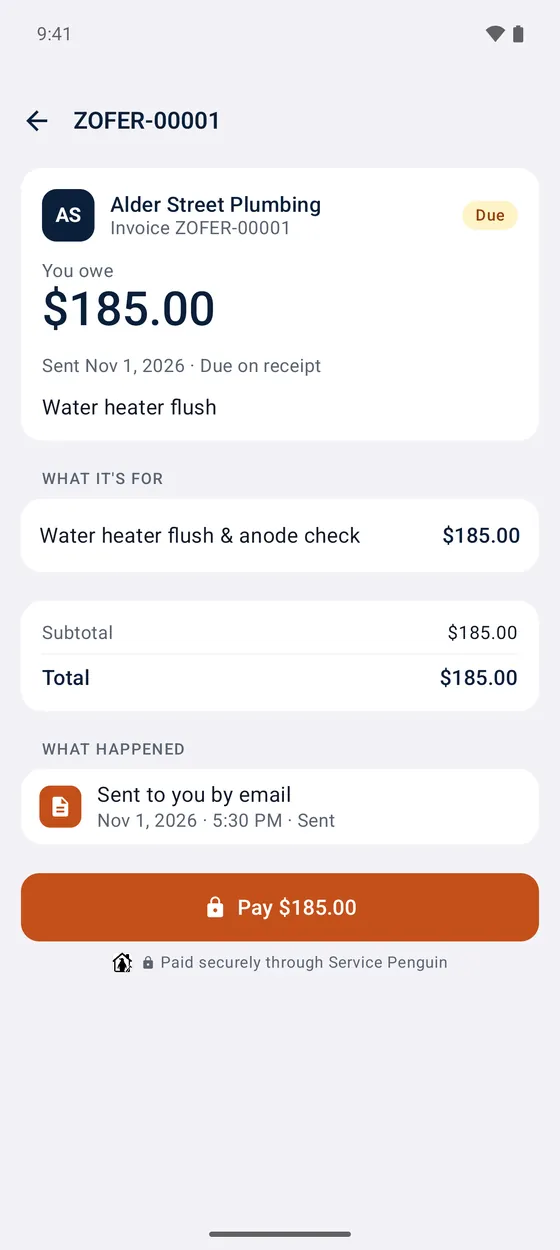
Send each invoice the same day its milestone is hit, with the due date on it. Know the other side too: in Florida, a residential contractor who has collected more than the value of work done may not stop work for 90 days, or another period written into the contract, under Florida Statutes section 489.126. Collecting ahead of the work puts obligations on you.
How to measure how much money you have riding on a job
Measure your exposure at each step: what you've spent and done, minus what you've collected. The formula:
Exposure = materials bought + cost of labor done − payments received
On the $4,800 example, say materials cost $1,600 and day one's tear-off and prep costs $500 in labor (example costs). Before the second payment, exposure is $1,600 + $500 − $480 = $1,620. After the $1,920 comes in, exposure is −$300.
A good schedule keeps exposure small in both directions. A big positive number means you're financing the job. A big negative number means the customer is, and that's where state rules start to bite.