
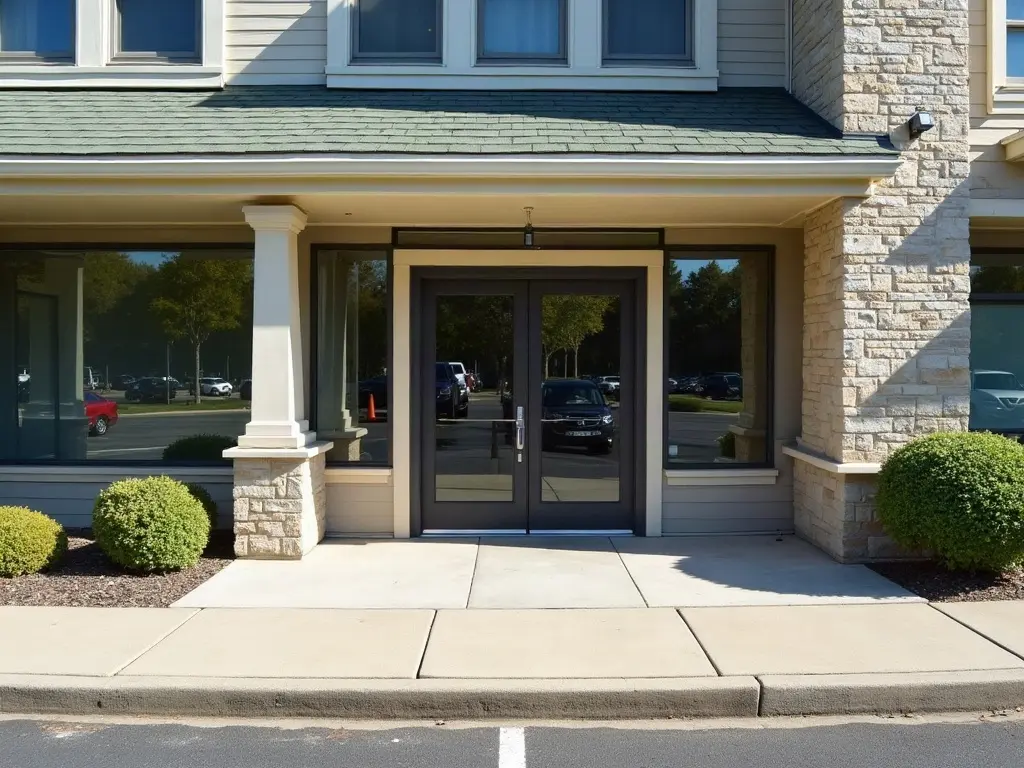
You win commercial pressure washing accounts by handing a facility manager a written offer they can approve without calling you. The offer names the exact surfaces, how often you clean them, how fast you respond, what's excluded, your insurance and a fixed price for each line. Your own numbers sit behind it, so every line you price makes money. A page that answers the buyer's questions before they ask beats "pressure washing available, call for a quote."
Which commercial pressure washing accounts should I chase first?
Chase buyers who already write scopes for this work: facility managers, property-management companies, retail centers, healthcare facilities, parking-facility operators and government buildings. Those buyer types appear again and again in published pressure-washing requests on SAM.gov, the federal contracting site. Courthouses and military installations appear there too, as in this listing.
The work in those requests goes well past sidewalks. Federal requests have covered building exteriors, parking facilities, overhangs, bridges, tanks, graffiti, oil and algae, as in this building-exterior requirement. You can offer each of those surfaces to a local property manager as its own line item.
Keep your list inside your route area. A retail center 10 minutes from your shop beats a bigger one 90 minutes away, because drive time comes out of every visit's margin.
What should a commercial pressure washing offer include?
A commercial offer should spell out the scope, surfaces, frequency, response times, exclusions, insurance and a fixed price for each line. Federal solicitations ask for that kind of detail. A private buyer comparing three bids wants the same thing, because detailed bids can be compared side by side.
- Surfaces: walls, walks, drive lanes, dumpster pads, each listed separately.
- Frequency: quarterly, monthly or another schedule, with the months named.
- Response time: how soon you arrive for an oil spill or overnight graffiti.
- Exclusions: roofs, interiors and sealing, unless you price them.
- Insurance: a current certificate, ready to send.
- Price: fixed per line, plus an on-call rate.
Buyers often combine scheduled maintenance with work on demand. One federal solicitation pairs routine cleaning with as-needed work. Offer both: the scheduled visits, plus a set rate for a call-out.
Price the whole term, not just the next visit. One federal facility contract ran a base year plus four one-year options, with prices broken out by period (see the solicitation). Showing prices for years two and three up front tells a manager you plan to stay.
Worked example: a quarterly retail center offer
Picture a small retail strip with four storefronts, a front walk, a drive lane and two dumpster pads. Every dollar figure below is an example only. Use your own timed jobs and costs.
Start with your cost per crew hour. Say a two-person crew costs $90 an hour all in: wages, payroll taxes, truck, fuel, chemicals and a share of insurance. Then time each surface on a similar job before you bid.
- Building walls: 5 crew hours × $90 = $450 cost. Price: $800.
- Sidewalks and storefront walks: 4 crew hours = $360 cost. Price: $640.
- Drive lane and entrances: 3 crew hours = $270 cost. Price: $480.
- Two dumpster pads, with degreaser: 1.5 crew hours = $135 cost. Price: $280.
One visit comes to $2,200 against $1,215 in cost, which leaves $985. Four visits make a base year of $8,800. Add an on-call rate for oil or graffiti, such as $250 to show up, including the first hour, then $160 per crew hour.
For renewals, raise the price 4% a year in this example. Option year one comes to $9,152 and option year two to $9,518. Contract rules vary by state, so have an attorney read any multi-year agreement before you sign it.
| Line item | Crew hours | Price per visit |
|---|---|---|
| Building walls | 5 | $800 |
| Sidewalks and walks | 4 | $640 |
| Drive lane and entrances | 3 | $480 |
| Two dumpster pads | 1.5 | $280 |
| Total per visit | 13.5 | $2,200 |
| On-call oil or graffiti | As needed | $250 + $160/hr after first hour |
How do I know which jobs make money?
A commercial job makes money when its price beats its full direct cost by your target margin. Measure that after each visit, not only when you bid. The formula:
Gross margin % = (price − direct cost) ÷ price × 100
In the example, ($2,200 − $1,215) ÷ $2,200 = 44.8%. Now say the walls actually took 7 crew hours instead of 5. Cost rises by $180 to $1,395, and the margin drops to 36.6%.
Track revenue per crew hour too, counting drive time: price ÷ (on-site hours + drive hours). The example has 13.5 hours on site and 1 hour of driving, so $2,200 ÷ 14.5 = $151.72 an hour. An account paying $110 per crew hour fills days you could sell for more.
A notebook handles this fine with two or three accounts: write the bid hours next to the actual hours after each visit.
How do I work with commercial customers who need a PO?
Get the purchase order number before the first visit and put it on every invoice, because many companies won't pay an invoice without one. Ask three more questions up front: who approves the work, who receives the invoices, and what payment terms the company uses, such as net 30.
Property managers and HOAs add a layer. The manager may approve the work, the HOA board may approve the budget, and an accounts payable office may cut the check. Send invoices to the billing contact, copy the manager, and keep the signed scope ready in case someone questions a line.
Build the waiting time into your planning. On net 30, your crew's wages for a $2,200 visit come out of your own cash until the check clears.
Can a small crew bid on federal pressure washing work?
A small pressure washing business can compete for federal work once it registers in the System for Award Management, and many requests are set aside for small firms. Federal pressure-washing work has been listed under NAICS 561790, Other Services to Buildings and Dwellings. The small-business size standard there is $9 million in average annual receipts, according to this SAM.gov listing.
Some requests were issued as total small-business set-asides under FAR Part 19.5, so eligible small firms don't bid against large companies. You can see one in this example set-aside. Some jobs are small, too: one building-exterior project was estimated at under $50,000 (solicitation).
Expect paperwork. A quote may need your UEI, small-business status, any certifications and supporting price information. Federal buyers commonly want a firm-fixed-price quote, broken out by base period and option periods, as in this solicitation.
Requirements differ by agency and by solicitation. Read each one in full, and ask the contracting officer it lists when something is unclear.